
Why I voted to continue discussing fire gear bond
I wanted to share some thoughts about Monday night’s finance committee meeting, where we considered a $2.6 million bond request to buy two new sets of gear for Quincy firefighters.
First of all, let me clear up some confusion: No vote was taken on the merits of the request – only on whether to continue the discussion or to move it out of committee for a final vote. Five of the councilors, including myself, voted to continue the discussion, which will happen at the next finance committee meeting this coming Monday night.
OK, now for more details:
Last August, the mayor held a press conference to announce that a set of gear purchased earlier that year that had been advertised as being free of fluorine-containing chemicals called PFAS had tested positive for them. That was a concern because the two most commonly used chemicals in that class are known or suspected carcinogens.
Six months later, on March 2nd, the mayor presented a bond request for two sets of non-PFAS gear to the council, and Monday’s meeting was the first opportunity the council had to discuss the issue. We heard from the interim fire chief, the president of the local firefighters union, the scientist who tested five sets of gear for PFAS, the city solicitor, and the city’s chief financial officer. Their comments were extremely informative, and councilors were each given up to 15 minutes to ask them questions.
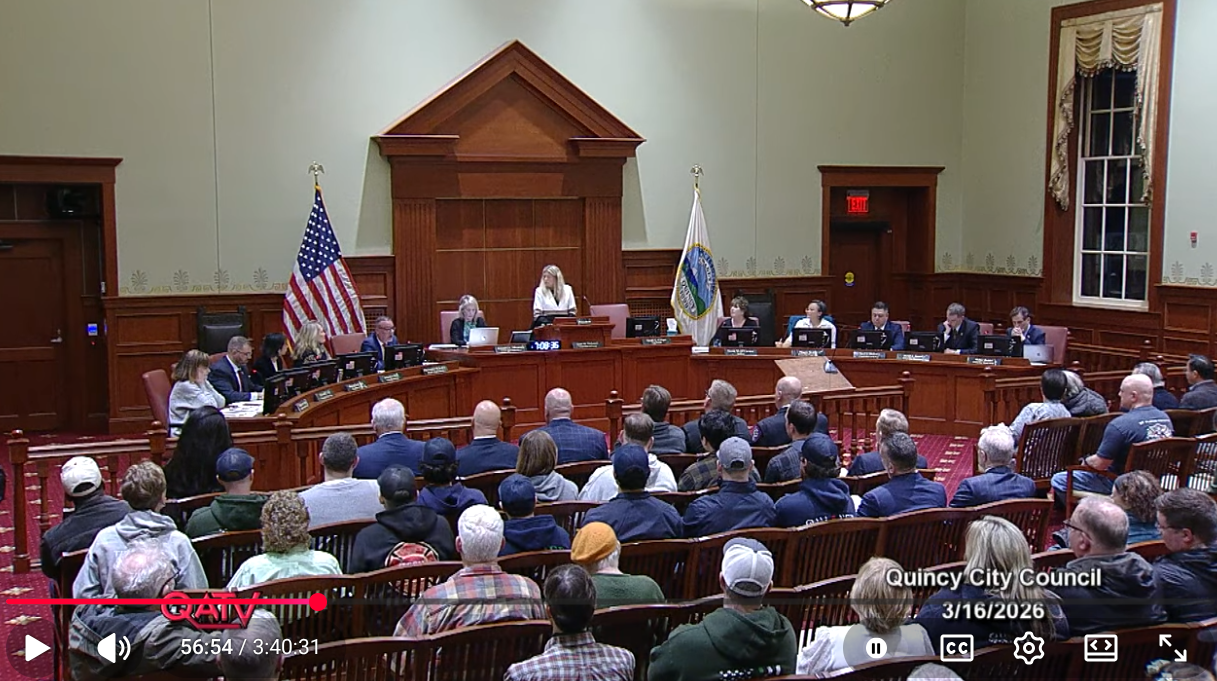
During my allotted time, I asked some context-setting questions, from how many firefighters Quincy has (281) to what the biggest source of PFAS is in both firefighters and the general population. The scientist, Graham Peaslee, said the biggest overall source for both is contaminated drinking water. (Fortunately, state testing shows no measurable levels of PFAS in Quincy’s water.)
Some recent research suggests PFAS chemicals can also travel through the pores of our skin, which is very relevant to the risk of PFAS in firefighter gear. Dr. Peaslee stated that research from 2024 suggests that perhaps 1 to 2% of the PFAS in gear can go through skin after 36 hours of use.
The fact that PFAS can come off the gear and go into skin, even in small amounts, made me remember that another scientist I had spoken with recently told me that some research suggests that washing gear in water can remove some PFAS. I thought that information might be helpful to firefighters, who are understandably concerned about PFAS exposure, and asked Dr. Peaslee about it at the committee meeting. He said that washing the gear’s thin moisture barrier could reduce the amount of PFAS on the barrier over time because the chemicals are not incorporated throughout the material. But he said his own research shows that PFAS remains present in substantial quantities in the thick outer shell of PFAS-treated gear even after 10 years and probably a hundred washes.
Many of the folks in attendance clapped when Dr. Peaslee said that, and I clarified that I didn’t mean to imply the PFAS would be entirely removed – just significantly reduced. I genuinely thought this information could be useful for firefighters.
I asked another question about different PFAS testing techniques, and after Dr. Peaslee answered, the committee chair told me my 15 minutes were up, leading to another round of applause.
After other councilors had been given a chance to speak, a vote was taken on whether or not to move the matter out of committee and to the full council for final approval. I, along with four other councilors, voted no on moving the matter out of committee because I still had questions and issues to discuss.
Since then, I have received a lot of messages from folks angry with my vote and my questions. Some think I voted against the gear, some imply I want firefighters to get cancer, some assert that the science on the impact of PFAS in gear is settled, some say I claimed that washing the gear would eliminate PFAS, some say I came off as unprepared, asking basic questions about the number of firefighters in the department. Many folks said I should be ashamed that I did not approve the bond request immediately.
But I would not be doing my job if I didn’t raise questions so that I and other councilors understand the issues before us and debate them in order to come to the best possible decision.
I know that the issue of PFAS in fire gear is a personal one for many people, and most of the folks who reached out to me about it either work for the fire department or have a loved one who does. Many described losing friends and family members in the field to cancer, which unfortunately is more common in firefighters than in the general population. I understand their worries, and I share them.
That is exactly why we need to take the time to understand the issues — by asking questions, doing research, and talking with others. It will help us do the necessary oversight to try to minimize those health risks.
I believe these issues warrant at least a brief discussion. Because if we don’t understand the risks of the gear we already have or the gear we’re considering buying, how can we be sure we're doing what is best for firefighters’ health?
I certainly don’t want to drag out discussion sessions interminably, but I could not in good conscience vote to approve the bond request for new equipment after one preliminary committee meeting. I hope to have a thoughtful conversation about this issue at Monday’s committee meeting, and I hope everyone attends or tunes in on QATV.
